
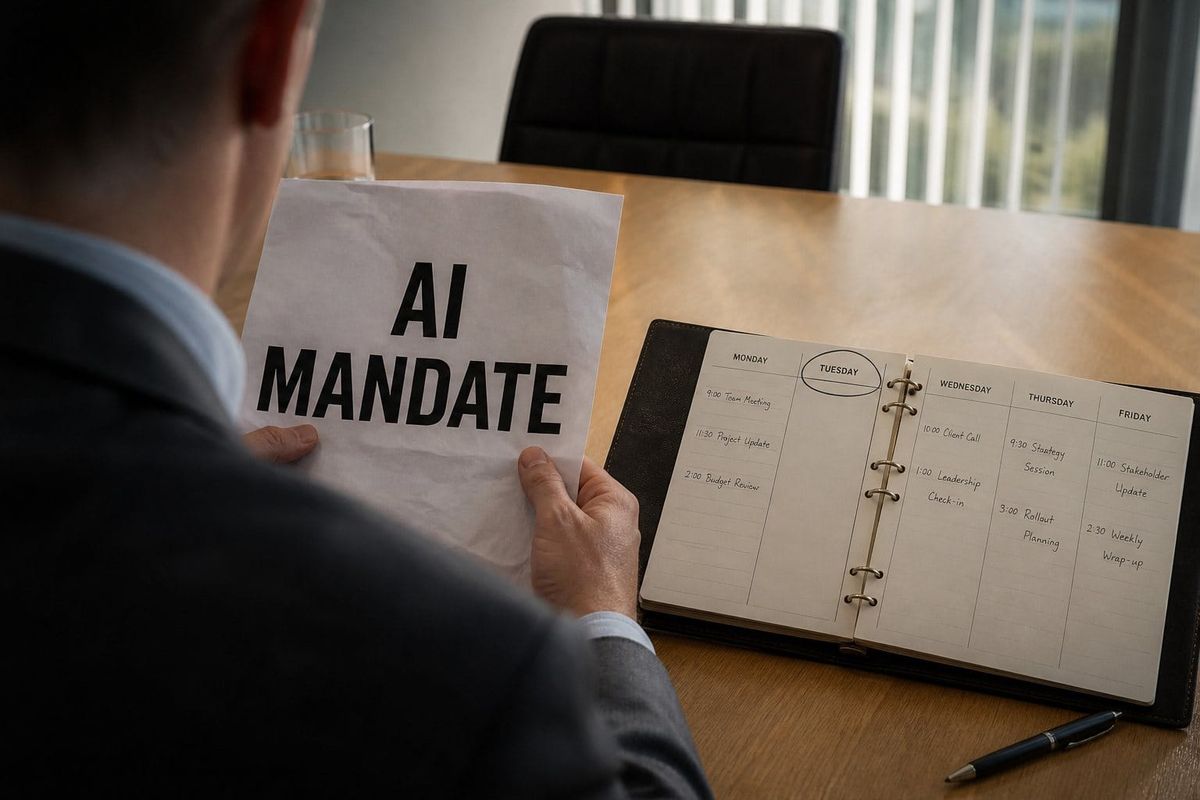
You got the AI mandate. Nobody told you what Tuesday looks like.
Last Friday I showed you my bill. This is the other half.
Last Friday I showed you my bill.
This is the other half.
Someone handed you a target.
Use AI. Catch up. Don't get left behind.
Then they asked what you shipped this week.
On Tuesday you still have the same jobs. The same people. The same calendar.
A mandate is an order from the top. The one you just got skipped the job, the owner, and what "done" looks like.
So most people do the safe thing.
Eight, Bob
Office Space already shot it. Stay for the last line.
Peter has eight bosses. When he screws up, eight people come by to tell him about it.
Then he says why he even comes in.
"It's a problem of motivation, all right? Now if I work my ass off and Initech ships a few extra units, I don't see another dime, so where's the motivation?"
His only real motivation is not to be hassled, and the fear of losing his job. "That'll only make someone work just hard enough not to get fired."
That is the mental model we already have for why people go to work. Do enough to keep the job. Don't overachieve. The money is just enough to stay.
A lot of AI mandates run on the same model. What's the motivation for putting one in place? Often it is Peter's. Don't be the company that "didn't do AI." Don't get hassled by the board.
Eight people can ask what you did with AI.
The safe Tuesday is to turn on Copilot, fill the seat budget, and go back to the week you already had. The mandate is checked. Nothing shipped.
Two headlines from this week
That is not just a movie.
Fortune on Thursday: companies are spending a fortune on AI. The people at the top are the least sure who is in charge.
The C-suite is that small group of top executives. Pearl Meyer is a firm that advises boards. They asked 116 board members and executives in May and June.
Only 34% of the C-suite said it is consistently clear which person or team makes the AI calls. Lowest of every group they asked. The board came in at 53%. Managers further down came in at 57%.
The people furthest from the mess feel settled. The people in the mess do not.
Fortune on Saturday: about 90% of executives, in a study from the Atlanta Federal Reserve, believe AI has not yet boosted productivity at their companies. Some of those same companies are still cutting jobs and putting AI on the press release.
That is Peter's week, at company scale. The mandate went out. Nobody owns Tuesday. The press release still shipped.
$4,693 is not the scare. The jump is.

A seat budget is that week. A bill that jumps is someone who gave the tool a real job.
Here is the July invoice. $4,692.94.
If that line sat on a 200-person company, it would be about $23 a head. Lunch. A software seat you forgot to cancel.
I am one person. June was $559. July was $4,693.
Ramp reads the cards and bills of more than 50,000 U.S. businesses. For July, the same month as that invoice, they divided each company's AI spend by headcount. That mix includes seats and tokens. Mine is tokens only.
The median firm spent $11.95 per employee. About one ChatGPT or Claude seat.
The top 10% spent $650 per employee.
The top 1% spent $7,400 per employee.
My July, as a freelancer with no team, landed between their top 10% and their top 1%. I am not a typical seat. I handed the tools a real job. $4,693 as a company total is nothing. A few people on a usage plan can still get there.
A Clutch survey of 600 U.S. small businesses already using AI found that half spend $50 to $500 a month on the tools. That is a company total. That is the neighborhood most shops live in.
A lot of business plans do not charge you per seat. They charge you for use. The tool reads. The tool writes. You pay the meter. The mandate says use it. The meter follows.
The bill should move. If it never moves, nobody actually used it.
The most enjoyable problem I have solved

Last weekend, at a wedding, someone asked me the most enjoyable problem I have ever solved.
Same choice I keep getting.
The ones I like end with a credit card and a Tuesday. Not a six-month build.
A small company I sat with had a real bottleneck. The owners were the help desk. The team could not move without asking them. They thought the fix was to stand up their own agent on a spare machine and point it at the whole company.
That is a science project. It can eat months. Tens of thousands, sometimes more. When the person who built it leaves, you still have the machine. You do not have the system. Six months later, when you finally turn it on, the work has already changed.
The work was already living in the project tool they paid for. We turned on the AI that came with it. We wrote a few small helpers that took the back-and-forth off the owners. We put the project notes in a shape a tool can search, so the team could get the answer without pinging leadership.
We did not give it the whole company. We gave it only what the job needed. The obvious seats would have been too open. This job needed tighter walls.
The add-on costs more than leaving it off. You can turn it up. You can turn it down. You can use it the same afternoon. Custom is a sunk cost that looks like progress.
Before you stand up a custom agent, list the tools you already pay for. Circle the one that already holds the work. Turn on the AI that ships with it. Give it only that work.
That is how you leave the safe week. You name the job that already exists. You turn on the tool that already holds it.
Stop paying it to count the R's

Once that job has a home, you still have a choice. You can keep asking the tool. Or you can make the answer stay put.
Most AI tools are non-deterministic. Same question, different day, you can get a different answer. The tool is guessing, in an expensive way. That is useful when you need judgment. A first draft. A messy problem. A call you have not made yet.
Deterministic means the opposite. Same input, same output, every time. A calculator. A function. A checklist a junior person can run. You do not argue with a calculator.
Do not pay the tool to count how many R's are in strawberry. Ask it once to write a small program that counts the letters in any word, and gets it right every time. Then run the program. Do not ask again.
Use the expensive, opinionated tool to invent the system. Use the cheap, boring system to run the job.
If the mandate is "use AI," a lot of teams keep the first kind on all day. The meter stays on. The answer moves. Nobody can say what done looks like, because done changed since lunch.
Spend the expensive thinking on the first version of the system. Stop spending it on the tenth rerun of the same job.
That is what we did for that team. The tool could find the answer because the work was in a place it was allowed to look. Then we stopped asking it the same question.
Steal this: the Tuesday card
You can write the first version this afternoon. One page. This is how you get out of Peter's week.
- Name one expensive recurring job. Something you already pay people or time for every week. Not a moonshot.
- Write the one person who decides if the work is good enough. A name. Not a committee.
- Write what "done" looks like in one sentence a non-expert can check.
- Write which tool is allowed to touch it. One. Not five.
- Send that page to the person who issued the mandate.
If you cannot fill those four lines, you do not have a program.
Steal this: make one job stop thinking
Pick the job on that card that you keep pasting into the tool.
- Ask the tool to write the function, checklist, or script that does it the same way every time.
- Run that. Check it against a case you already know.
- Put it next to the job. Do not leave it in the chat.
- The next time the job shows up, run the system. Do not re-ask the tool.
When the next vendor shows up, hold up the page. If their tool cannot do that job, under that owner, you are not buying it this quarter. If they want six months and a spare machine, you already have the answer.
If that page exposes a real problem
I have been doing this for over a decade. My own companies. Fortune 100 companies. I was already in it when the tools got good. I spent the time and the money so you can skip the expensive part of the learning.
I translate that gap. Process. Tools. Where to focus. I do it on the actual work, not a slide about the work.
If that page exposes a real problem, I have one September seat open. It is for a company that wants to improve one revenue, time, or cost system.
The engagement is $9,500 a month for an initial three months, including one 90-minute working session each week. We work on the real system.
Reply with the problem and the number you want to change.